 Pandurang Waghulde
Ruby gem feature_flags new features (0.1.0)
Back again with new features in the Ruby gem feature_flags (0.1.0).
Here is my blog post on the old version of feature_flags. I recommend going through it first if you haven’t, to learn about the other features available in this gem.
Memoization of features is the main change in this version, and it really improved performance. It’s much faster now.
What’s new?
1. Memoization
In previous versions, it fired an SQL query every time you checked whether a feature was enabled:
FeatureFlags.enabled?(:feature_name)Worried about that? Now you don’t need to be. It fires the SQL query only when something has changed in the database, and memoizes the result, which speeds it up a lot.
2. Check multiple features at a time
There may be situations where you need to check several features together:
if FeatureFlags.enabled?(:feature_name1) && FeatureFlags.enabled?(:feature_name2) && FeatureFlags.enabled?(:feature_name3) ## some codeelse ## some codeendThat gets long quickly, so now you can do it like this:
if FeatureFlags.enabled?([:feature_name1, :feature_name2, :feature_name3]) ## some codeendSo when you have more than one feature to check at once, pass them as an array of feature names. If you have a single feature to check, just write:
if FeatureFlags.enabled?(:feature_name) ## some codeend3. Check if any of the given features is enabled
if FeatureFlags.enabled_any?([:feature_name1, :feature_name2, :feature_name3]) ## some codeendThis runs the code inside if any one of :feature_name1, :feature_name2 or :feature_name3 is enabled.
4. UI changes
You can now do everything on a single page (add, edit, enable, disable, remove):
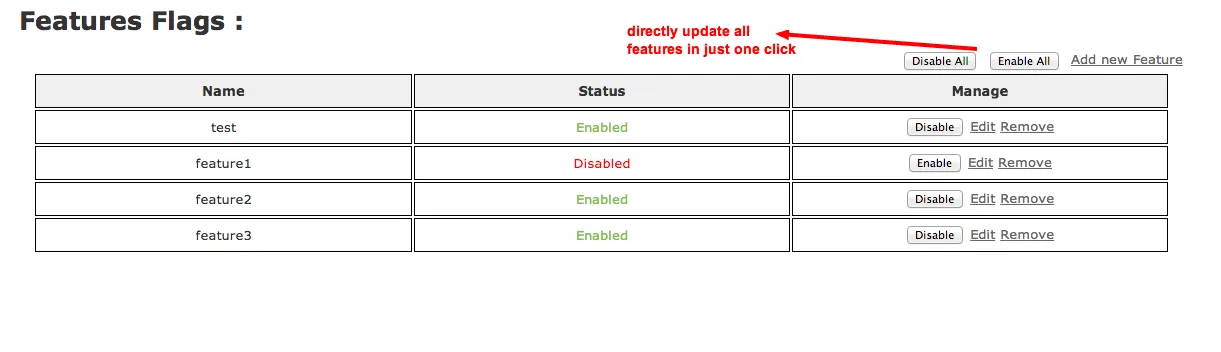
If you are already using a previous version (<= 0.0.3) and want to migrate to this version (0.1.0), then after updating the gem, just add the following line to your model:
include FeatureFlags::FeatureBaseAnd if you had generated the views before, generate them again to get the updated ones:
rails generate feature_flags:viewsThat’s it, you are done. :)